Multi-Agent AI: The Future of Enterprise Workflows in 2025
Multi-Agent AI: The Future of Enterprise Workflows
The AI landscape has shifted. We're no longer talking about chatbots that answer questions or copilots that suggest code. In 2025, the conversation has moved to agentic AI — autonomous systems that can perceive, reason, decide, and act across complex business workflows with minimal human intervention.
And the data backs it up:
- Gartner projects that 40% of enterprise workflows will incorporate agentic AI components by end of 2025
- Deloitte estimates 25% of enterprises using GenAI will launch agentic pilots this year, doubling to 50% by 2027
- The agentic AI market is forecast to grow from $5.25B in 2024 to $199B by 2034
Single AI agents are powerful. But the real transformation happens when multiple specialized agents collaborate — negotiating, delegating, and orchestrating end-to-end processes that no single agent could handle alone.
From Single Agents to Multi-Agent Ecosystems
Traditional automation follows rigid scripts. A single AI assistant handles one task at a time. Multi-agent systems represent a fundamentally different architecture:
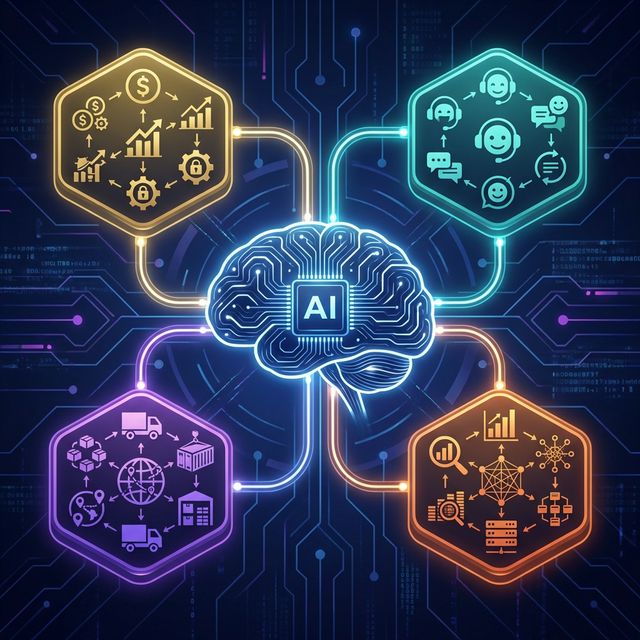
- Specialized agents handle distinct domains (finance, customer service, supply chain, HR)
- An orchestrator coordinates task delegation, priority, and handoffs
- Agents communicate with each other — sharing context, requesting help, and escalating exceptions
- The system adapts to changing conditions without human reprogramming
Think of it like a high-performing team where each member has deep expertise, and a project manager ensures everything flows smoothly.
Real-World Multi-Agent Use Cases
1. Intelligent Supply Chain Management
A multi-agent system for supply chain might include:
- Demand Forecasting Agent — analyzes historical sales, weather, events, and market signals
- Inventory Optimization Agent — adjusts stock levels across warehouses in real-time
- Supplier Negotiation Agent — monitors pricing and automatically triggers reorder workflows
- Logistics Coordination Agent — optimizes routing, tracks shipments, and handles exceptions
These agents operate continuously, exchanging information and coordinating decisions that would take a human team days to process.
2. End-to-End Customer Experience
| Agent | Role | Impact |
|---|---|---|
| Intent Classification Agent | Understands customer needs in real-time | 70% faster routing |
| Resolution Agent | Handles common issues autonomously | 60% ticket deflection |
| Escalation Agent | Detects sentiment drops and routes to humans | 35% higher CSAT |
| Follow-Up Agent | Proactively checks satisfaction post-resolution | 25% churn reduction |
3. Financial Operations Automation
Multi-agent systems in finance are reducing month-end close times by 50–70%:
- Data Reconciliation Agent matches transactions across systems
- Anomaly Detection Agent flags discrepancies in real-time
- Compliance Agent ensures every transaction meets regulatory requirements
- Reporting Agent generates audit-ready financial statements
The ROI Is Real
Enterprises deploying multi-agent AI are seeing measurable returns:

| Metric | Result |
|---|---|
| Average ROI | 171% across early adopters |
| Processing Time Reduction | 50–70% for automated workflows |
| Operational Cost Savings | 30–40% reduction in manual effort |
| Error Rate Improvement | 80% fewer human errors in data processing |
| Speed to Market | 3x faster product iteration cycles |
These aren't projections — they're reported outcomes from enterprises that have moved beyond pilots into production deployment.
Building a Multi-Agent Architecture: Key Principles
1. Start with the Workflow, Not the Technology
Map your highest-value, most complex workflows first. Multi-agent AI shines where:
- Processes span multiple departments
- Decisions require diverse data sources
- Speed and consistency matter
- Human bottlenecks create delays
2. Design for Human-in-the-Loop
The most successful implementations maintain graduated autonomy:
- Tier 1: Fully autonomous for routine decisions
- Tier 2: Agent recommends, human approves
- Tier 3: Human leads, agent assists with analysis
3. Invest in the Orchestration Layer
The orchestrator is the brain of your multi-agent system. It needs to:
- Route tasks to the most capable agent
- Handle failures and retries gracefully
- Maintain shared context across agents
- Enforce governance and compliance rules
4. Build for Observability
Every agent decision should be traceable. Implement:
- Decision audit logs
- Performance dashboards
- Feedback loops for continuous improvement
- Alert systems for anomalous behavior
The Multi-Agent Maturity Model
| Stage | Description | Timeline |
|---|---|---|
| Stage 1: Single Agent | One AI assistant per use case | Where most are today |
| Stage 2: Coordinated Agents | Multiple agents with basic handoffs | Early 2025 |
| Stage 3: Collaborative Swarms | Agents negotiate and optimize together | Mid-Late 2025 |
| Stage 4: Autonomous Ecosystems | Self-organizing agent networks | 2026+ |
Most enterprises are at Stage 1 or early Stage 2. The competitive advantage goes to those who move to Stage 3 first.
How Spring Software Builds Multi-Agent Systems
At Spring Software, we specialize in designing and implementing multi-agent architectures for enterprises. Our approach:
- Workflow mapping — we identify the highest-ROI processes for agent automation
- Custom agent development — purpose-built agents with domain expertise
- Orchestration design — robust coordination layers with governance built in
- Iterative deployment — start with a pilot, prove ROI, then scale
The multi-agent future isn't theoretical. It's being built right now — and the enterprises that move first will define the next decade of competitive advantage.
Schedule a discovery call to explore how multi-agent AI can transform your operations.
Related Posts
From Zero to AI Agent: What to Expect From a Hands-On AI Workshop
A practical guide to what happens inside a hands-on AI agent workshop — from architecture patterns to deploying your first working agent.
The Rise of AI Agents in Enterprise Software
Discover how AI agents are transforming business operations and why 2026 is the year of agentic automation.
AI Agents in Finance: Transforming Trading, Risk, and Compliance
Explore how AI agents are revolutionizing the financial services industry with 24/7 automated trading, intelligent risk assessment, and proactive compliance monitoring.