Enterprise AI Automation: Breaking Down Silos with Intelligent Agents
Enterprise AI Automation: Breaking Down Silos with Intelligent Agents
Enterprise organizations face a paradox: they invest billions in technology, yet their systems often don't communicate effectively. Data sits trapped in silos. Processes require manual handoffs between systems. Employees spend hours copying information from one application to another.
AI agents offer a revolutionary solution — acting as an intelligent integration layer that understands context, navigates complexity, and executes work across disparate systems.

The Enterprise Automation Challenge
Large organizations typically operate with:
- Dozens of core systems (ERP, CRM, HRM, Finance, etc.)
- Hundreds of departmental applications
- Thousands of spreadsheets and databases
- Legacy systems that can't easily be replaced
Traditional integration approaches — APIs, middleware, ETL pipelines — address parts of this challenge. But they're rigid, expensive to maintain, and can't handle unstructured data or ambiguous processes.
How AI Agents Transform Enterprise Operations
The Intelligent Integration Layer
AI agents excel at bridging gaps between systems:
- Natural language interfaces that let employees query any system
- Context-aware routing that sends information to the right places
- Data transformation that handles format differences automatically
- Exception handling that escalates issues intelligently

Key Enterprise Use Cases
1. Cross-System Workflow Automation
AI agents can manage workflows that span multiple systems:
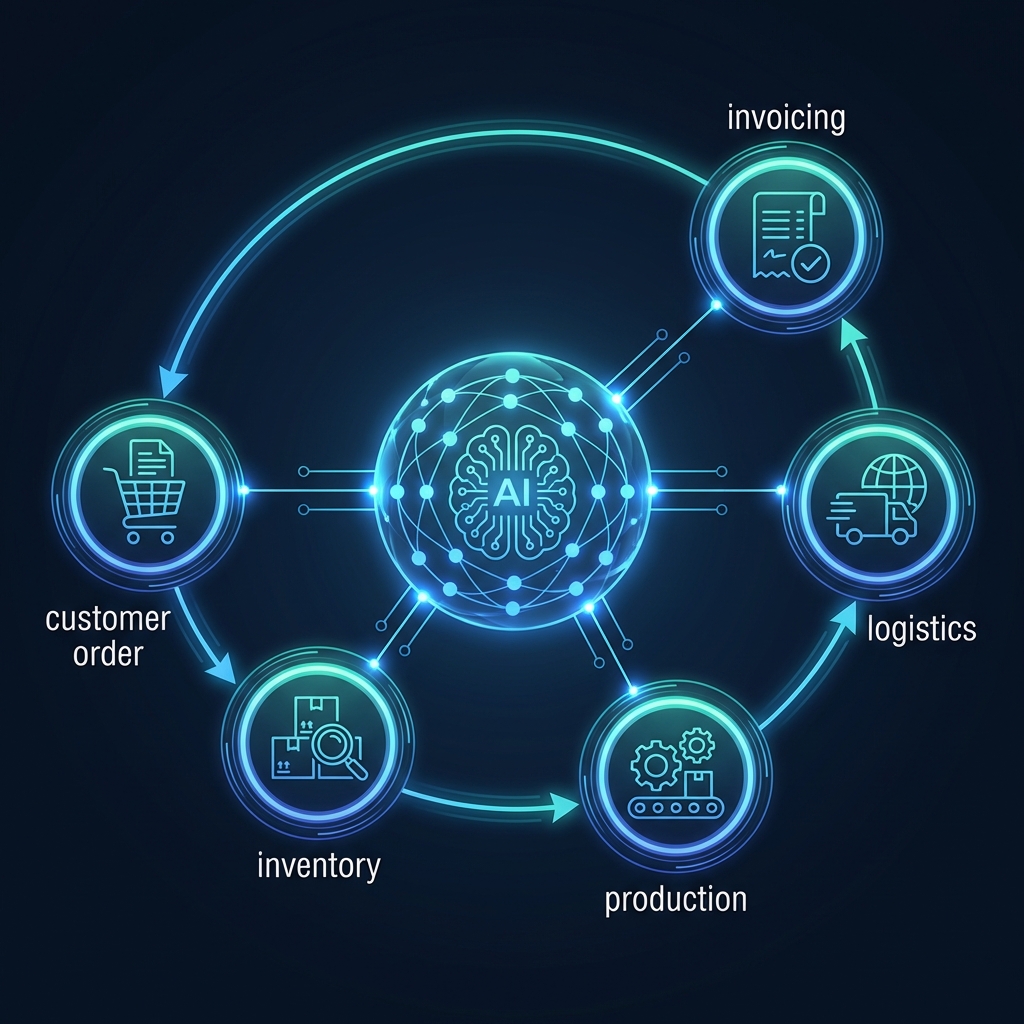
Customer order → Inventory check → Production scheduling →
Logistics coordination → Customer notification → Invoice generation
Each step might involve a different system. An AI agent orchestrates the entire flow, handling exceptions and keeping stakeholders informed.
2. Intelligent Document Processing
Enterprises process millions of documents annually. AI agents can:
- Extract information from unstructured documents
- Validate data against multiple systems
- Route documents for appropriate approvals
- Archive and index for future retrieval
3. Employee Self-Service
Instead of navigating complex internal systems, employees can simply ask:
"What's my PTO balance, and can I take next Friday off?"
The AI agent queries HR systems, checks team calendars, and can even submit the request if approved.
Measuring Enterprise AI ROI
Organizations implementing AI agents typically see:
| Metric | Improvement |
|---|---|
| Process Cycle Time | 50-80% reduction |
| Manual Data Entry | 70-90% elimination |
| Error Rates | 40-60% reduction |
| Employee Satisfaction | Significant increase |
Implementation Roadmap
Phase 1: High-Value Pilot (Weeks 1-4)
- Identify a contained, repetitive process
- Deploy an AI agent with clear success metrics
- Establish governance and monitoring
Phase 2: Expansion (Months 2-6)
- Scale to additional departments
- Connect more systems
- Develop internal expertise
Phase 3: Enterprise Scale (Months 6-12)
- Organization-wide deployment
- Advanced use cases
- Continuous optimization
Security and Governance
Enterprise AI agents must operate within strict boundaries:
- Role-based access control mirroring existing permissions
- Complete audit trails for compliance
- Data sovereignty respecting geographic requirements
- Human-in-the-loop for critical decisions
Transform Your Enterprise
At Spring Software, we've helped organizations across industries implement AI agents that deliver measurable business value.
Schedule an enterprise consultation to explore how AI agents can accelerate your digital transformation.
Related Posts
The Rise of AI Agents in Enterprise Software
Discover how AI agents are transforming business operations and why 2026 is the year of agentic automation.
The ROI of AI Agent Implementation: Building the Business Case
A practical guide to understanding and calculating the return on investment for AI agent deployments, including common metrics, cost structures, and time-to-value expectations.
Family Office AI Solutions: Personalized Service at Scale
Discover how AI agents are helping family offices deliver white-glove service to ultra-high-net-worth clients while managing growing complexity and regulatory requirements.